Tiered Equity Pricing
When I started this business back in 2017, I set a purpose-led constitution. Since then, I’ve incorporated BCorp clauses that ensure long-term decisions and prioritize positive impact for people, communities, and the planet. To me, tiered equity pricing is yet another way to weave conversations of accessibility, sustainability and valuable work into the very fabric of this organization. Tiered equity pricing helps me to ensure my work is available to a diverse range of people and organizations, not only those with the deepest of pockets.
WHAT IT IS
Tiered equity pricing is a pricing structure designed to address systemic inequalities in our economic model of capitalism. You may be familiar with tiered pricing in which payment amount for a product or service varies, and oftentimes a higher price point includes bonuses or extras. However, with tiered equity pricing, you pay different amounts for the same product or service. In this case, everyone receives the same scope of services from me, however you might pay a different amount depending on your circumstances.
Tiered equity pricing makes visible underlying assumptions about supply and demand, financial security and value-based pricing. Instead of assuming that everyone’s financial reality is the same (or that someone is undeserving of a product or service until they can meet their basic needs), tiered equity pricing allows for diverse financial realities, and prices accordingly. I invite you into the conversation.
The products and services on this website offer tiered equity pricing in order to be accessible to people with a variety of financial capacities. Participants are invited to choose a pricing tier that reflects their reality, for example:
Supported tier - For people with limited financial security, or no financial safety net.
Sustainable tier - This tier covers the true cost of the work and ensures we can continue to offer the work sustainably.
Community care tier - When you choose a higher tier, you enable us to fund others, participate in wider community and pro bono work and strengthen the whole system.
Everyone receives the same high-quality offering, and the pricing model reflects equitable access.
WHY IT MATTERS
Equity and equality are not the same thing, although the words may sound similar. Equality means that each person is given the same resources or opportunities, yet does not consider underlying, systemic imbalances that may hinder a ‘starting position’. Equity recognizes that each person has different circumstances, and allocates resources and opportunities needed to reach an equal outcome.
You may have come across the fence diagram (or maybe an apple tree) which helps illustrate the differences visually:
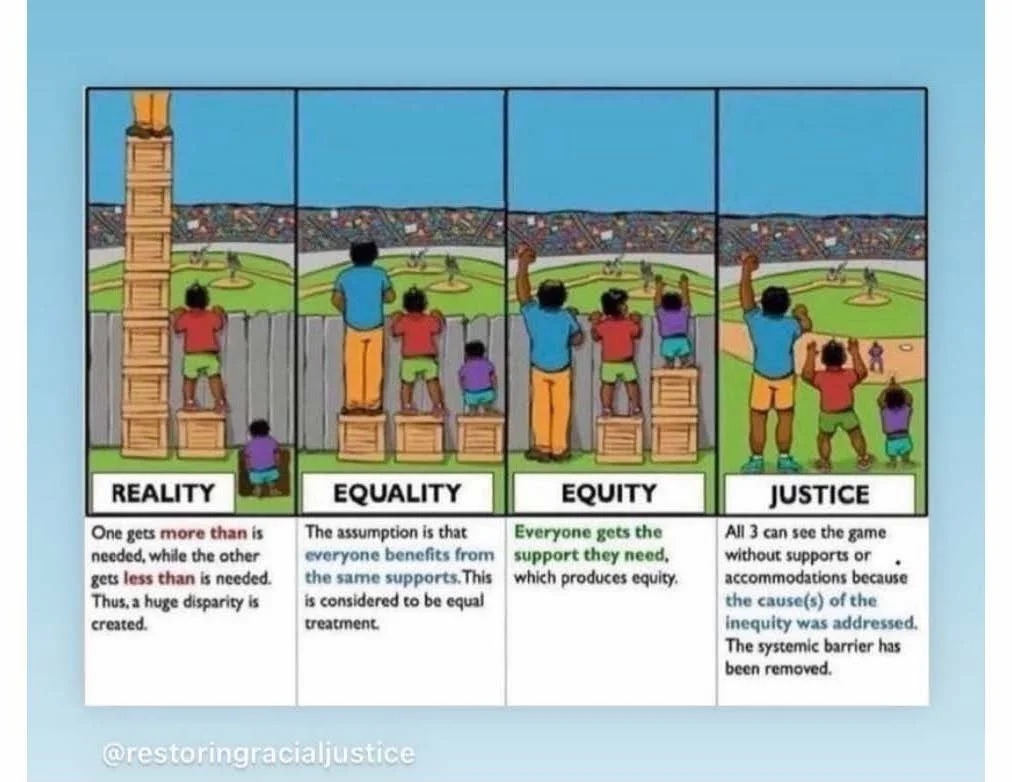
Image credit - https://www.RestoringRacialJustice.com - via instagram - @RestoringRacialJustice
WHY I USE IT
For me, tiered equity pricing is about making the work accessible to clients who have a wide variety of budgets and needs - and acknowledging the different circumstances people are living. The model reflects a commitment to address community care, systemic inequality and unconscious bias and privilege in a field prone to neglecting real consideration and action on these issues (corporate leadership).
Every time you choose a higher pricing tier, you are directly impacting our ability (that’s you and me) to scale this work as a community. Your financial contribution enables the work to be offered to people from more marginalized circumstances, and organizations who might not have the same funds available to advance their purpose - e.g. non-profits and social justice activists. This enables a wide array of purpose driven organizations to flourish in their work, and in turn strengthens the whole community in which we live and work on this planet.
Here’s what the numbers look like as we enter January, 2026:
Supported
9
(includes scholarships)
Sustainable
71
Community Care
0*
*Our community care tier launches this year, 2026.
HOW YOU PARTICIPATE AND CHOOSE YOUR TIER
I invite you to take time considering the pricing tiers on offer, and choose a contribution that reflects your financial security and privilege of place. You might choose to think about your own access to resources, what you can genuinely afford, the value of this work, and price of other comparable programs.
Community Care - Contributes towards the scholarship fund, nourishes a diverse and vibrantly entangled community beyond ourselves. When you or your organization contribute at this level, you are enabling those who might otherwise not have access to engage with and share this work within their communities. This price is for those who are financially well resourced, may be funded by their organization, and reflects the true value of this work in a Western economic market.
Sustainable - For those who have medium access to financial resources, this tier ensures that we can continue to offer this work sustainably into the future.
Supported - Enables access for those on low incomes, who lack financial safety net, or for whom the sustainable tier would undermine your ability to meet the basic needs of your household (food, medicine, clothing, shelter).
Scholarship - Offered by application, where participants do not pay for the product or service (in some cases, participants may need to fund their travel to and from a venue).
In return for your engagement in a tiered equity model, I commit to regularly review our pricing within the current market conditions. Further, I recognize that some communities have suffered historic inequality which continues today. If you identify as being part of an historically, or currently marginalized or oppressed population, then I invite you to contribute at a lower tier than your current financial situation if you choose to.
This is an honour based system. Should you need further guidance, you might find the following reflection questions helpful in considering your choice:
Do I struggle to meet my basic needs for food, medicine, clothing and shelter?
What is my annual income?
In addition to (or in place of) my annual income, what other financial safety nets, resources or privileges are available to me (e.g. family support, assets and investments, superannuation or retirement funds, inheritance, trust funds).
Am I in debt? Can I afford the repayments on that debt?
Assuming I have discretionary spending money available, where do I choose to spend it?
What amount would be a stretch for me to pay, so that I feel it, but without causing long term harmful consequences because I have paid more than is within my means?
What is my relationship with money and how I choose to engage with it - making, spending, sharing, accumulating - what emotions do I attach to these activities? What are my beliefs about who has money and who does not?
Am I willing to actively engage in the dismantling of a system that privileges me, in which I sit at the top?
What value do I place on intangible outcomes, like those which might come from a program such as this, and can I trust in the long term transformative benefits of this work?
FOLX WHO HELPED TO INSPIRE THIS MODEL:
Cascadia Quest, Leaders for a Wild Regenerative Future - https://cascadiaquest.org
Future Ancestors Services Inc, Next-Generation Speakers Bureau - https://www.futureancestors.ca
Restoring Racial Justice, Transforming Education - https://www.restoringracialjustice.com/
SomaPsych, Trauma Informed Practice - https://somapsych.org
Tristan Katz, Marketing & LGBTQ+ Inclusion Consulting - https://www.katz-creative.com